Aquatic plants
All 16 of the aquatic plants modeled from botanical descriptions available in the aquascaping simulator Aquageorama.
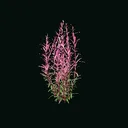
Rotala rotundifolia
A stem plant with narrow leaves in dense crossed pairs. Upper leaves turn pink to red in strong light, and side shoots form soft background bushes.
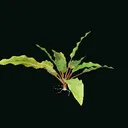
Cryptocoryne wendtii
A hardy crypt whose wavy, lance-shaped leaves rise on reddish-brown stalks from a sheathed base in a vase shape. In low light the stalks grow tall; in strong light the leaves lie flat in a star. Runners make daughter plants that clump in the foreground and midground.
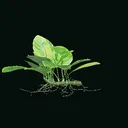
Anubias nana
Dwarf anubias: glossy, dark green oval leaves crowd the tips of a creeping rhizome into a dome. Green leaf stalks clasp the rhizome, and roots grip rock or wood. Grows slowly; old leaves may carry spots of algae.
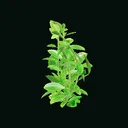
Ludwigia repens
A hardy stem plant with glossy oval leaves in cross-wise opposite pairs on short stalks from a thick stem, filling the background with a bright green bush.
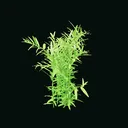
Rotala sp. Green
A stem plant with narrow, bright green leaves in crossed pairs. It stays green even in strong light, grows up then bows over and sends up side shoots, forming soft rounded bushes.
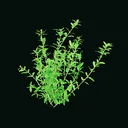
Pearl grass
Tiny lance-shaped bright green leaves sit in star-like whorls of 3–4 along thin stems. Many stems arch outward and branch into a dense bush for the fore- and midground.
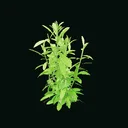
Hygrophila polysperma
A hardy stem plant with bright green, oblanceolate leaves in crossed pairs. Short, flat stalks hold arching leaves, and white roots grow from the lower nodes. The upper leaves turn bronze in strong light. Branches freely and grows fast.
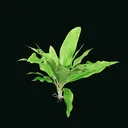
Amazon sword
A large rosette plant: bright green, lance-shaped leaves fan out like a fountain from a pale sheathed base, arching over with gently rippled margins. It forms plantlets on its flower stalks; a narrow-leaved form also exists. A background centrepiece.

Java fern
An aquatic fern whose long, narrow fronds, quilted between the side veins, rise from a creeping rhizome. Its dark roots cling to rock or wood. Grows in dim spots.
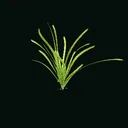
Vallisneria spiralis
Ribbon leaves of even width rise in a bundle from a pale base and arch over near the top. The tips are rounded and a translucent band runs along the midrib. It spreads in rows by runners with daughter plants, forming a swaying background curtain.
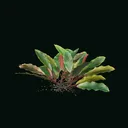
Bucephalandra
A small aroid from the rocky streams of Borneo. Glossy leaves with wavy edges crowd on red stalks at the tips of a creeping stem, their surface glittering with fine dots. New leaves are red, and there are bronze and blue-sheened forms. Its roots grip rock or wood, and it grows slowly.
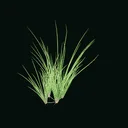
Dwarf hairgrass
Needle-thin stems stand in tufts. Thread-like white runners put out a new tuft at every node, spreading into a lawn.
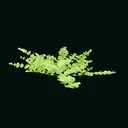
Monte Carlo
Small round leaves in pairs. Thin stems creep over the substrate and root at each node, forming a soft, bright green mound.
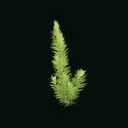
Hornwort
A rootless stem with whorls of 8 to 11 thread-like leaves at every node. Each leaf forks once or twice, and the stem tip ends in a bright green brush of young leaves. Grows well floating or planted in a bunch.
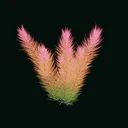
Rotala wallichii
A stem plant with a dozen or more needle-thin leaves in a whorl at every node. The stem tip is a feathery plume, and under strong light the upper part turns orange to pink. It branches more near the surface and grows bushy.
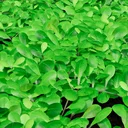
Glossostigma
A foreground plant with tiny spoon-shaped leaves in pairs along creeping stems; the stems grow over one another into a thick green carpet.